Showing posts with label MOVIE STUFF. Show all posts

Thursday, May 9, 2024

UMGAWA!!!

 From 2005.

Every now and then I lose all hope for the entire human race and I need a dose of the unwavering moral certainty put out by superheroes and what they represent, especially the pre-1960’s variety of good guys.

 Back in the days there were no real shades of gray to our heroes. You were either a good guy or a bad guy. It was that simple. Some were more violent and cynical in their methods than others — the Shadow and the pre-Robin Batman spring immediately to mind, since both did not hesitate to send villains to join the Choir Invisible — and others handed out ass-kickings that came from a more primal, earthy standpoint, such as Conan, Billy “The Mucker” Byrne, and Enkidu, co-star of the Mesopotamian epic of Gilgamesh (how can you not get with a superhuman wildman who is civilized in no uncertain terms by the twin influences of friendship and serious pussy?). But none of those resonate in my estimation quite like Tarzan of the Apes, so today I went out and finally got my paws on the boxed DVD set of the first six MGM films about him. 

I have absolutely fucking loved Tarzan for as long as I can remember, one of the very few things my father and I had in common, and I still smile at the memory of my dad telling a five-year-old Bunche about how the word “Umgawa” was the jungle lord’s all-purpose word that could literally be applied to any situation whatsoever and work like a charm, a fact proven time and again throughout several of his films from the early 1930’s through around 1948. Perhaps my father’s one positive lasting influence upon me was spurring my interest in the heroes of his youth, especially Tarzan and Buck Rogers in the Twenty-Fifth Century, both of whose comic strips amazingly launched on the very same day in 1929 (although both had first debuted in pulp magazines years earlier)… 

But I digress. 

Moving to the hostile and racist land of Westport, Connecticut in the summer of 1972 — I had just turned seven — I had no real friends save the little blonde girl across the street, Nora, would play with me in the vast, untamed swamp near I-95, and our favorite game was “Tarzan and Jane,” a much more interesting variation on “House.” I remember Nora in her Jane persona loving the idea of having a husband who was some wild jungle guy and a “child” who was a stuffed bear who also doubled as “Cheeta" the chimp, and complaining about how she and her mate were always more or less naked, and noting her strange interest in nudity in general, but we were clothed throughout all of this innocent kiddie role playing. Without even intending to explore its meaning we had hit upon one of the most intriguing elements of the cinematic Tarzan/Jane dynamic, namely that the two were primal, sexual creatures whose relationship was in no way prurient, just fun, innocent and utterly natural. Sadly, Nora moved away a few months later and I would not have any friends who had any kind of imagination for several years to come (plus I would have loved to have borne witness to the beauty that I’m certain she became). 

During the 1970’s in the Connecticut area, kids got their education on Tarzan from weekly Sunday afternoon screenings of films about him on New York’s Channel 5 — and the seldom-seen reruns of the Ron Ely television series from the 1960’s, which was not bad — and I can honestly say I saw all of them, but the details of many of the earlier entries faded from my childhood memories and were only awakened and really understood when seen again from a grownup perspective. Cases in point: TARZAN THE APE MAN (1932) and even more so TARZAN AND HIS MATE (1934), both films from before the hypocrisy and bullshit of the Hayes code (look that one up on Google; way too much to cover here). 

The first two of the MGM Tarzan flicks are violent as hell, politically incorrect to an alarming degree for modern viewers (depictions of Africans back in those days were less than flattering, to say the least), and surprisingly hot when it came to the Tarzan and Jane romance. What really blows me away upon seeing the MGM entries nowadays is how wrong I was in my original assessment of the films. As a child I loved them but upon getting older and reading creator Edgar Rice Burroughs’ novels I was shocked to find the jungle lord was extremely articulate, fluent in several languages (French was his first non-simian tongue), and that Jane was a blonde American rather than the British brunette of the movies, and I perceived those deviations from the source material to be both insulting and a flagrant example of dumbing down some really great stuff. Well lemme tell ya, sometimes things that are altered for the movies can work out to be exactly right for the onscreen medium. The casting of non-actor and badass of the 1924 and 1928 Olympics, Johnny Weissmuller, proved to be brilliant since his Tarzan exhibited an animal wariness and athletic physicality that I honestly do not believe could have been gotten across by a stage or screen thespian. And don’t get me started on the absolute perfection of Maureen O’Sullivan’s Jane. Here was a love interest who was not only utterly lovely, but she was every bit as savvy and fearless as Tarzan (once she said “fuck civilization” and started swinging through the trees), and was also the kind of lady that guys just plain love and unless some ass-kicking on a rubber crocodile or rallying of an elephant herd was needed, Jane was pretty much the brains of the operation. Pretty radical for the 1930’s, I think. 

The first two of the MGM Tarzan flicks really focus on Jane and her rebirth as a “natural” woman after accompanying her father on a quest for the mythical “Elephant’s Graveyard,” a site that exists on a remote African plateau that also happens to be the home of Tarzan. In TARZAN THE APE MAN our nature boy abducts Jane from the safari, strictly out of innocent curiosity, and when he hauls her up to his tree home Jane is terrified — as is the audience — when it appears that Tarzan’s rough attentions are a preamble to rape rather than a desire to check out someone who is obviously different from him, different in a way that he has never encountered since he is the only human where he resides (or so we are supposed to believe, despite an abundance of black people all over the goddamned place). Jane soon realizes that she is in no danger, and begins to warm to the ape-man, openly voicing how hot she thinks he is and her relief at the fact that she can make such statements since he can’t understand her nattering in English. The smoldering gazes between the two are volcanic in their heat, and pretty soon Tarzan scoops Jane into his arms, looks up at his tree and nods to her as if to ask “Are you feeling this too?” Jane buries her face in his neck in silent agreement and the two retire to the arboreal love-nest, at which point the scene fades out and the screen goes dark for a surprisingly long time… When next we see Jane, she is unusually relaxed for a 1930’s movie heroine and embraces the Big Guy while blatantly expressing her obvious pleasure in his unrefined charms. It’s plain to even the most obtuse member of the audience that the Beast With Two Backs has been made, and by the time the story winds up Jane has ditched both the English stiff who digs her and the British notion of modest social propriety in general for the wild life with her loincloth-clad Lothario (and his chimp companion Cheeta). 

The sequel, TARZAN AND HIS MATE, is considered by many — including your humble Bunche — to be the best Tarzan movie ever made, and is chock full of all the excitement, sex, and violence that one could want in a movie even by today’s standards, so when it came out back in 1934 it raised a major ruckus. This time around, a party of irritating British shitheads arrive at Tarzan’s escarpment with the intention of returning Jane to England since there is no way that any sane white woman would enjoy being out in the wilds of Africa, what with all the animals, heat, Negroes, and that smelly, yodeling white guy in the leather banana-hammock. Well, they are in for a big shock when after hiking up the dangerous mountain face for the first half-hour of the movie, they find Jane not only happy to the point of lunacy, but also clad in as little as Hollywood would permit in 1934, an immodest state that she doesn’t even notice since she’s having the time of her life and has absolutely no intention of fucking up such a good thing by going back to Blighty (I told she was smart!). On the other hand, Tarzan is proven to be an attentive, playful and considerate lover, and since he does not bear the taint of uptight Western bullshit-as-values he is not jealous of the former suitor of Jane’s who has lead the expedition to find her since he knows that they are perfect mates and that nothing short of death could part them. Tarzan’s almost entirely silent love for his woman is truly powerful to behold, and when both characters are looked at as archetypes for both genders — the non-verbal he-man type and the talkative nurturer — their enduring appeal can be readily understood, an appeal made that much more interesting by the plainly illustrated fact that Jane is obviously the real power in their dynamic.

The thing really stuns modern viewers when they see TARZAN AND HIS MATE is the obvious sexual and loving relationship shared by the protagonists, and the fact that such a situation was seen in a major Hollywood film from 1934. There are a couple of scenes wherein we encounter our heroes after a night of flaming osh-osh and Jane is sexily nude under some sort of animal skin, lovingly gushing to Tarzan, and let us not forget the infamous nude swim scene in the river where we see a crystal clear bare-assed Jane (another Olympic swimmer doubling for Maureen O’Sullivan) and the lord of the jungle innocently frolicking together in the same way that couples do if they happen to be nude and not engaged in the aforementioned flaming osh-osh. I could go on about all of this, but I’d like to let the following user comment from the Internet Movie Database say it all for me: 

Author: (tom_amity@hotmail.com) from Lincoln, Nebraska, 2/2/2005 

Hard to believe, perhaps, but this film was denounced as immoral from more pulpits than any other film produced prior to the imposition of the bluenose Hayes Code. Yes indeed, priests actually told their flocks that anyone who went to see this film was thereby committing a mortal sin.

I'm not making this up. They had several reasons, as follows:

Item: Jane likes sex. She and Tarzan are shown waking up one morning in their treetop shelter. She stretches sensuously, and with a coquettish look she says "Tarzan, you've been a bad boy!" So they've not only been having sex, they've been having kinky sex! A few years later, under the Hays Code, people (especially women) weren't supposed to be depicted as enjoying sex.

Item: Jane prefers a guileless, if wise and resourceful, savage (Tarzan) to a civilized, respectable nine-to-five man (Holt). When Holt at first wows her with a pretty dress from London, she wavers a bit; when Holt tries to kill Tarzan, and Holt and Jane both believe he's dead, she wavers a lot. But when she realizes her man is very much alive, the attractions of civilization vanish for her. And why not? Tarzan's and Jane's relationship is egalitarian: He lacks the "civilized" insecurity that would compel him to assert himself as "the head of his wife". To boot, he lacks many more "civilized" hangups, for example jealousy. When Holt and his buddy arrive, Tarzan greets them both cordially, knowing perfectly well that Holt is Jane's old flame. When Holt gets her dolled up in a London dress and is slow-dancing with her to a portable phonograph, Tarzan drops out of a tree, and draws his knife. Jealous? Nope. He's merely cautious toward the weird music machine, since he's never seen one before. Once it's explained, he's cool.

Item: Civilized Holt is dirty minded. Savage Tarzan is innocently sexy. As Jane slips into Holt's lamplit tent, Holt gets off on watching her silhouette as she changes into the fancy dress. By contrast, after Tarzan playfully pulls the dress off, kicks her into the swimming hole and dives in after her, there follows the most tastefully erotic nude scene in all cinema: the pair spends five minutes in a lovely water ballet.(The scene was filmed in three versions--clothed, topless and nude--the scene was cut prior to the film's release, but the nude version is restored in the video now available.) And when Jane emerges, and Cheetah the chimp steals her dress just for a tease, Jane makes it clear that her irritation is only because of the proximity of "civilized" men and their hangups. Where is the "universal prurience" so dear to the hearts of seminarians? Nowhere, that's where. Another reason why the hung up regarded this film as sinful.

Item: The notion that man is the crown of creation, and animals are here only for man's use and comfort, takes a severe beating. Holt and his buddy want to be guided to the "elephant graveyard" so they can scoop up the ivory and take it home. They want Tarzan to guide them to said graveyard. You, reader, are thinking "Fat chance!" and you're right. He's shocked. He exclaims "Elephants sleep!" which to him explains everything. Jane explains Tarzan's feelings, which the two "gentlemen" find ridiculous.

Item: Jane, the ex-civilized woman, is far more resourceful than the two civilized men she accompanies. Holt and buddy blow it, and find themselves besieged by hostile tribes and wild animals. It is Jane who maintains her cool. While the boys panic, she takes charge, barks orders at them and passes out the rifles.

Item: Jane's costume is a sort of poncho with nothing underneath. (The original idea was for her to be topless, with foliage artistically blocking off her nipples, which indeed is the case in one brief scene.)

Lastly, several men of the cloth complained because the film was called "Tarzan and His Mate" rather than "Tarzan and His Wife." No comment!

Of course, Tarzan, who has been nursed back to health by his ape friends, comes to the rescue, routs the white hunters, and induces the pack elephants and African bearers to return the ivory they stole to the sacred place whence it came. The End.

So there you have it. An utterly subversive film. Like all the other films about complex and interesting women (see, e.g., Possessed with Rita Hayworth and Raymond Massey) which constituted such a flowing genre in the early 30's and which were brought to such an abrupt end by the adoption of the Hays Code.

The joie de vivre of this film is best expressed by Jane's soprano version of the famous Tarzan yell. A nice touch, which was unfortunately abandoned in future productions.

Let's hear it for artistic freedom, feminist Jane, and sex.

Very eloquently stated, I think, and how can you not immediately want to see a film condemned by The Church? So yesterday, after having a great non-barbecue lunch at the lower East Side’s esteemed Crif Dogs (a repast of two chili dogs and a side of tater tots), I bought the Tarzan DVD set and have set about enjoying my two days off by watching Tarzan flicks until I go mad in an effort to restore my faith in humanity; it is now 4:07 AM on Tuesday morning, and I’m still at it, and ya know what? These journeys to that otherworldly cinematic Africa are doing me a lot of good, and I hope to someday find the right Jane to complement my own inimitable Tarzan. Wish me luck.

Friday, January 19, 2024

IMITATION OF LIFE (1959) AT THE FILM FORUM

From 2015.

Lobby card from the film's original release, featuring Susan Kohner as the troubled Sarah Jane Johnson.

Just got back from the Film Forum's screening of IMITATION OF LIFE (1959), a film that has fascinated me since I first encountered it in the great Esther Newton's infamous "American Society On Film" class during my SUNY at Purchase college days. It's a re-imagining of a 1934 chick flick/"weepie" about two mothers, one black and one white, and their daughters, who all come together under one roof as a blended family and contend with issues of class, race, and family dysfunction, and the 1959 version is one of the all-time classic examples of a textbook emotionally-manipulative Hollywood soaper. Its examination of how American society of its era made true equality/harmony between blacks and whites in general unlikely at best and hauls out the longstanding tropes of the martyred, saintly older black woman who's the emotional backbone and real strength of the family (to both black and white factions), and the so-called tragic mulatto whose case of self-loathing is invariably more compelling than the upper-class travails of the white protagonists.


Sarah Jane (Susan Kohner), surrounded by white masks. Subtle it is not...

I won't spoil the plot's details but the 1959 IMITATION OF LIFE's portrait of Sarah Jane (Susan Kohner), the angry, self-loathing light-skinned daughter of a black father who's described as "almost white," is far more compelling than the rote rags-to-riches showbiz rise of its white main character (Lana Turner) and how her success leads her to unintentionally neglect her blossoming 16-year-old (Sandra Dee). The actress's storyline is not bad by any means, but it was something that was already seen numerous times prior to the film's release, however it's essential to the overall narrative by providing the perfect background against which to contrast the entwined lives of Sarah Jane and her mother (Juanita Moore) who works as the actress's live-in maid and bosom companion whose support and caring for the actress's daughter frees the actress to pursue stage gigs. Sarah Jane's rejection of her dusky heritage and her shattering desire to pass for white from an early age form the true emotional core of the story and Susan Kohner's Oscar-nominated performance renders the character's arc as nothing less than painful and heartbreaking. In short, if you have not seen this film, seek it out for Kohner's arc.


Which brings me to last night's Screening at the Film Forum, where I met the one and only Susan Kohner. Kohner's spectacular portrayal of the deeply troubled, self-loathing Sarah Jane Johnson struck a very strong chord with my mother's side of the family, especially with a certain aunt who basically was the character in real life. (Though Sarah Jane never ran into the same kinds of issues with the law that the aunt in question did, but the less said of that the better...) Following the film, Kohner sat for an interview with a film professor  — whose questions/expoundings were of little or no weight and who clearly missed the entire point of the movie he was allegedly such an authority upon; that assessment was shared by a friend of mine who was also in attendance and is a highly-knowledgeable film scholar and director of films herself — and later answered questions from members of the audience. Since the opportunity was afforded, I took the mic and told Kohner of how much her character and performance meant to my family and especially my aunt. Following that, she was also kind enough to pose for a shot with her that I will send to the interested parties in my family, especially the aforementioned aunt.

 Yer Bunche, with the one and only Susan Kohner.

Wednesday, August 5, 2020

DAIKAIJU 101: A FIELD GUIDE TO TOHO'S GIANT MONSTERS

(Originally published in 2004)

After watching GHIDRAH, THE THREE-HEADED MONSTER yet again a few days ago, I started thinking about the rich pantheon of giant monsters (or "daikaiju" as the japanese call them) that the geniuses — and to be honest, also hacks, specifically Jun Fukuda — at Toho studios have allowed to run rampant onscreen since 1954. Many are majestic and mystical, some are ass-out ridiculous and some are just plain embarrassing. If you are reading this then you are also part of a dying breed of monster fan, and it’s now time for the hardcore geek-out. Much like the endless debate among comics fans about “who’s strongest?” there are many such debates raging at all times regarding the monstrous spawn of the Land of the Rising Sun, and while you may be well-versed in such matters you probably aren’t at my Sir Kenneth Clark-like level of geekish knowledge on these affairs, so it’s my duty to set the record straight on giant monsters and it’s your duty to disseminate the following utterly useless assessment among those whom you know to be like-minded. Just remember that Gamera, despite the 1990's Toho-produced trilogy, was originally a competitor from Daiei studios, so he and his many low-rent foes ain't gonna be discussed here. So without further ado:

GODZILLA

Somehow managing to stay completely awesome for over fifty years (!!!) and many series entries that turned him alternately into both a puppy dog and a pussy, there is simply no substitute or equal for the Big G. Originally envisioned as a symbolic anthropomorphization of the horror of nuclear devastation, Godzilla has since muscled his way into the popular consciousness as the unstoppable juggernaut par excellence of the whole daikaiju breed; armed with an atomic heat ray, regenerative powers that pretty much make him invulnerable, that cool-ass roar, an incredibly bad attitude and the most identifiable signature theme tune this side of James Bond and Shaft, Godzilla just plain rules.

VERDICT: a solid 5 out of 5, despite years of wimped-out versions and that fucking Hanna-Barbera cartoon.

ANGUIRUS

Showing up in the first sequel to the original Godzilla and sticking around ever since (despite being decisively killed during his first appearance, much like Big G himself), Anguirus is basically a gigantonormous hedgehog. No cool powers, no interesting origin, just simply some dude crawling around in a goofy costume and letting loose with a cry not unlike an asthmatic wheeze. Other than its recent appearance in GIANT MONSTERS ALL-OUT ATTACK, Anguirus has never been more than the sidekick who accompanies Godzilla when he has to kick some tag team ass on other rubber-suited critters in such anti-epics as GODZILLA ON MONSTER ISLAND (in which it talks! Talks, for Christ’s sake!!!) and GODZILLA VERSUS MEGALON.

VERDICT: a useless motherfucker if ever there was one, Anguirus should have been retired after its first appearance, but is somehow nonetheless considered a welcome presence due to its longevity. Fuck that shit, this Spiny Norman wannabe is lame. 2 out of 5.

VARAN

Showing up only once after its own self-titled movie, Varan is perhaps the biggest failure of the Toho monsters who were intended to spawn a series. Just like the original concept for Big G, Varan is an ancient monster who shows up in the then-present day to wreak havoc, the difference being Varan can’t carry a movie. Basically another giant lizard, Varan has some sort of super-breath and the ability to fly thanks to membranous wings that stretch from its armpits to its ankles. The original Japanese version of VARAN THE UNBELIEVABLE (1962) contains nearly a half hour of monster mayhem footage that was excised for no apparent reason for the American version and subsequently replaced with incredibly boring footage of some American GI and a kimonoed Japanese woman who looks suspiciously like she was found hanging out on Sunset Boulevard; in short, both versions suck out loud. Not seen since DESTROY ALL MONSTERS (1968), let’s hope that this oversized Rocky the Flying Squirrel will continue to languish in well-deserved obscurity.

VERDICT: so lame that it needs a crutch, Varan earns the dreaded 1 out of 5.

RODAN

The textbook example of how initial potential can be subsequently squandered, Rodan has not fared well over the years but is still kinda fun. After a spectacular debut in the first of the color Toho monster films, Rodan was reduced to a google-eyed, cartoony-looking puppet that didn’t do much but fly around in circles. In the first film, there were two of the damned things, and they are among the few giant monsters that actually ate people. I earnestly hope for some sort of decent handling of this character in future, but it seems unlikely, and that’s pretty sad for a monster that seems to have inspired the lyrics from Gas Huffer’s “Crooked Bird”:

When you hear that crooked bird, just close your shutters tight
Heed the warning written here and live to see the light
If you look into the sky you’ll catch its eye
It will alight…

VERDICT: the monsters seen in the first film get a solid 4, but the later goofy version and the so-called “Fire Rodan” each get a 2.

MOTHRA


Despite being pretty much ruined after its 1960’s appearances, Mothra started out in what is arguably the best of Toho’s monster/fantasy epics and was at the time the only Toho monster that was actually a god (or goddess if you include the first two appearances). The American version tries to pass off the ludicrousity of a Giants Stadium-sized moth by attributing such gigantism to the ever-popular atomic radiation excuse, but in the original japanese version Mothra had actually been worshipped as a deity by those South Seas Islanders for quite a while; long enough for a culture to have grown around said worship, along with the presence of those tiny twin chicks who are explicitly stated in the Japanese dialogue to be a couple of faeries. No other monster since Godzilla has caused so much fucking destruction that it can be considered a force of nature; rules of science and modern weaponry simply do not work against Mothra since such human concepts pale before the power of primal Earth magic. Mothra’s origins and qualities are strongly Shinto in many respects, and who other than those wacky Nips would come up with such an idea as a world-shattering caterpillar? I mean, we’ve all seen it swimming across the ocean, looking like nothing so much as giant “floater” doody, as the navy endlessly bombards it with everything they’ve got and Mothra just swims blithely on in a single-minded mission to rescue her priestesses. Cities crumble in its wake, and though a goddess of peace, Mothra’s main lesson is simple: “Don’t fuck with my faeries.” And who can forget when she decides it would be easier to get around if she could fly, so she constructs a huge cocoon on the Tokyo Tower?

When the army hits the cocoon with an atomic heat ray and the now winged Mothra emerges with nary a scratch — and a cry that makes me think she’s screaming an especially mocking “Nyaah Nyaah!” — you realize that she just can’t be stopped. Once she gets the faeries back she ceases all ass-kicking and heads home, happy as Michael Jackson at a Cub Scout gathering. Sadly, that Mothra croaked during her next appearance but her mantle was carried on by her twin offspring, neither of whom come off as anywhere near as tough as their mom. In subsequent features there is only one Mothra, with no mention of what happened to the other (shades of Rodan!). And do not get me started on the 1990’s revival wherein Mothra is a fucking alien who protects the Earth or some such bullshit! NOTE: don't miss the rerun of CHEERS where the guys go to a Toho festival at the drive-n and Frasier snobbily blurts out "What the hell is that? A giant moth?" and is promptly given a patient and informed guided walk-through by the bar's resident idiot, Woody, on just who the monsters are.

VERDICT: The original Mothra is one of the all-time great monsters, so she gets a rock-solid 5. The subsequent critters to bear the name are all pretty and shit, but they just don’t have the godlike awesomeness of the original. They all get a 3.

KING GHIDORAH

Easily the most visually splendid of the Toho menagerie, Ghidorah (or Ghidrah if you prefer) is pretty much like some Lovecraftian space alien, only on crack and with the ability to breathe focused microwaves. Sheer, balls-out evil, Ghidorah has always managed to be a hell of a lot of fun even when the movies that he’s in suck out loud. And I defy you to find a cooler entrance than when it first showed up as unformed energy erupting from a psychedelic fireball in the Kurobe Gorge; I once watched that one on mushrooms and HOO BOY was it cool! However, I won’t discuss MechaGhidorah since who needs to see such a kickass monster turned into what amounts to a cyborg nitro-burnin’ funnycar?

VERDICT: Visually awesome, a total badass, Satan in a three-headed rubber suit. Need I say……5?


GOROSAURUS

A lackluster sort-of Tyrannosaurus who looks exhausted after taking a really major jalepeno dump. It evidenced some sort of super-kick against King Ghidorah for about two seconds in DESTROY ALL MONSTERS, but other than that feeble display Gorosaurus really serves zero purpose.

VERDICT: A stone-cold bore, but he gets a 2 from me because he isn’t offensive, just boring. "Borosaurus," perhaps?

KING KONG

Okaaaay… The real (read “American”) Kong is the greatest movie monster ever. Period. Kimono Kong showed up only twice and during its first appearance it was one of the flat-out most bogus-looking creatures ever to stomp a city, and he was a fucking drunk to boot! And as much as I hated the comedy of KING KONG VERSUS GODZILLA, I have to confess that I love the famous publicity photo of Kong with his arms outstretched while Godzilla is burning off his nuts with an atomic heat ray blast (which I have yet to locate online). The suit is a bit better in KING KONG ESCAPES since it no longer looks like a black Donald Duck in a fur coat, but he’s still not all that.

VERDICT: Even the Dino DeLaurentis version is better. 2
(NOTE: Since writing this, I have taken to referring toi this iteration of Kong as "Kimono Kong.")

MINYA

I fucking hate Minya, him and his mutated/retarded-looking ass. End of discussion

VERDICT: 1 is the loneliest number that you’ll ever do…

BARAGON

Is it just me, or does this critter resemble a huge, goofy puppy with a horn on his forehead? All it does is burrow around a lot, occasionally breathe fire and look really silly — which is hard to do when you’re starring opposite a 130-foot-tall Japanese Frankenstein. Oh well, at least it eats people.

VERDICT: 2

FRANKENSTEIN

The origins of this monster remain somewhat cloudy; he’s either a creature that generated out of the disembodied heart of the Frankenstein monster which is irradiated at Hiroshima, or he’s an orphan who ate said irradiated heart and subsequently gets hit by the ugly stick and sprouts up like a motherfucker. I go with explanation number one, but it is specifically mentioned that his features are not Caucasian, so who the fuck knows? Anyway, other than the fact that he’s a giant Frankenstein with astounding regenerative powers this guy has nothing going for him; sure, he kicks Baragon’s ass, but so could pretty much any monster. Sadly, Japanstein has been relegated to the vaults of memory since his one and only starring turn.

VERDICT: Frankenstein earns a 2 solely for the sheer goofiness of him being a giant ugly Japanese dude in a Tarzan suit. And that Fred Flintstone fashion sense is pretty damned kooky; I mean, where did he get animal skins that big?

MECHAGODZILLA

The name says it all, however the merits of this character vary widely from film to film. Its two Seventies appearances come off as nothing more than feature-length toy commercials and its design only drives that point home more bluntly, but since the Godzilla series had degenerated into straight-up kiddie flicks by that point that comes as no surprise. Aggressively silly, Mechagodzilla was pretty much a saurian version of Giant Robot from the TV series Johnny Sokko and his Flying Robot, complete with those missile launcher fingers. The nineties were kinder to Mechagodzilla as his revamp in 1993’s GODZILLA VERSUS MECHAGODZILLA proves in spades; now basically a vehicle controlled by yet another anti-Godzilla paramilitary team rather than the tool of evil space aliens, Mechagodzilla is a seriously ass-kicking piece of hardware who gives Big G a run for his money.

Things only get better with the latest incarnation, which features a semi-cyborg version infused with Godzilla’s own DNA. Visually impressive and packed with weaponry up the ass, this is an opponent worthy of the Big G. And that Absolute Zero Ray…fucking awesome!!!

VERDICT: The early version was a joke, but the two most recent variations are cool enough to warrant a solid 5, especially the most recent one.

MECHAKONG

Predating Mechagodzilla by nearly ten years, this robotic version of Kimono Kong was developed to dig for radioactive ore that the real Kong couldn’t handle. It inevitably gets into a rather ho-hum fight with the real deal and that was that. Not very interesting but at least it looked cool.

VERDICT: 2 purely for the visual.

SPIGA

Known as Kumonga in Japan, Spiga occupies a unique place on the roster of the Toho beasts because it is actually scary. In case the name doesn’t ring a bell, we’re talking about that big-ass spider in SON OF GODZILLA; remember it now? That motherfucker had me under the coffee table when I was a wee Bunche and it still looks sinister. Basically a big, hairy marionette, Spiga had a grace of movement unusual for a giant monster and that only makes it more disturbing.

VERDICT: Spiga gets a 4 for being different.

MANDA

A classical Asian dragon brought to life by a none-too-convincing puppet, Manda is pretty useless as a threat. Other than getting its ass kicked by the super-submarine Atragon and derailing an elevated train in DESTROY ALL MONSTERS, Manda is wicked boring.
VERDICT: 2

HEDORAH

Better known as the Smog Monster, Hedorah is pretty badassed for something that looks like a crazed egg fu-yung surmounted with a big pair of greasy testicles. Able to spew incredibly corrosive farts that melt people on contact — no, seriously! — and armed with an appetite for industrial smokestack bonghits, Hedorah is the personification of pollution (which its name literally translates as) and for that reason alone it needs a serious ass-kicking. It’s also apparently female, since after Godzilla decisively kills it, Big G gorily reaches into its abdomen and removes its eggs.

VERDICT: Visually unpleasant, greasy, wiggly and about as close to a Cthulhoid critter as you’ll find in one of these flicks, Hedorah is major bad news and sort of resembles a walking ocean of frat boy vomit, in fact I swear you can almost smell it. Its movie may have been pretty bad, but I really, really love this monster. 5

EBIRAH

More commonly referred to as “the Sea Monster,” this giant escapee from an Arthur Treacher’s shrimp special has nothing going for it other than looking pretty realistic. Godzilla kicked its ass pretty easily, but then again what do expect from a monster whose name literally translates as “shrimp-rah?”

VERDICT: Earns a 3 purely for its visual and that mean batting claw.

KAMIKIRAS

The group name for those big-ass praying mantises in SON OF GODZILLA. These guys were visually interesting, but that’s about it.

VERDICT: 2

GABORAH

This guy was the big, electric bully monster in the infamous GODZILLA'S REVENGE, and his appearance was the second major harbinger of the kiddie-oriented direction that the series was headed in (the first bad omen being Minya). Fantastically silly-looking, colored like a rotting banana and possessing one of the most annoying monster noises ever, this guy was a loser from the second he showed up on screen. I mean, how tough can you be when you live to pick on Minya? Yeah, I know that standing up to bullies was pretty much the point of that film, but these are fucking monsters for Christ’s sake, not humans, and to see them act like people is just plain ludicrous.

VERDICT: 2 solely for the fact that just seeing this guy makes me laugh.

BATTRA

The visually stunning “battle version” analog of the 1990’s Mothra. Craggy, covered with horns and looking sort of like a Big Daddy Roth hot rod adapted to bug form, Battra was the one good thing to come out the movie that spawned it.

VERDICT: 4

GIGAN

A strong contender for the stupidest-looking Toho monster, Gigan has the distinction of being able to almost single-handedly restore fun to even the worst of Big G movies (see GODZILLA ON MONSTER ISLAND). Let’s break him down: a one-eyed bird head, foofy fairy wings, tusks, horns, gigantic singular claws instead of hands and feet, and la piece de resistance — a big fucking buzzsaw that stretches from its neck to its nuts. Always evil and with a bad attitude, Gigan exists to goofily kick ass and is a joy to behold. Easily the best thing to come out of the kiddification of the series.

VERDICT: A solid 4 for sheer entertainment value; so what if he doesn’t make a lick of sense?

DOGORA

Pretty much forgotten these days, this bizarre alien only showed up once in the movie bearing its name. It was pretty much a huge, floating jellyfish-thing that ate diamonds, which was a downer for the jewel thieves who were the protagonists of the movie. No personality to speak of, but it was really cool looking. Too bad the movie's boring like no other Toho flick before or since...

VERDICT: 4 for the visual.

SANDA and GAIRA

The brown and green Gargantuas, respectively, from the much-beloved WAR OF THE GARGANTUAS. One good and shy, one evil and man-eating, everybody loves these guys because of their tragic brotherly interdependence. These guys score very high on the character meter despite a total lack of superpowers other than their size (although the Gaira can survive underwater). By the way, in a detail obscured by the American version of their film, Sanda and Gaira are the result of cells shed by Japanstein in the ocean and the woods

VERDICT: A solid 4 for each of the big boys.

TITANOSAURUS

A so-called “gentle monster” who is controllable by humans. That’s pretty much it, folks.

VERDICT: 1

MEGALON

Another of the great silly monsters, Megalon is basically a “mega-roach” with a bad attitude, drill hands and a hankering to kick ass. His one film really sucks the hairy nutsack until he shows up with Gigan in tow to tag team Godzilla and everyone’s favorite blatant Ultra-Man ripoff, Jet Jaguar. That fight is a classic of sheer stupid fun, and should not be missed. And when all is said and done Megalon is a pretty hardassed monster!

VERDICT: A well-deserved 4.

MOGERA

The first of the giant Toho robots (from 1957’s THE MYSTERIANS), Mogera is pretty much a blending of a giant robotic mole and feudal samurai armor design with ocular death rays thrown in for good measure. Reinvented as “the ultimate weapon” in the disastrous GODZILLA VERSUS SPACE GODZILLA, Mogera has never been terribly interesting and deserves its place in relative obscurity.

VERDICT: Mogera gets a 2 purely for its first appearance, wherein it looked cool wandering around the countryside blowing shit up.

BIG-ASS OCTOPUS

For some reason the Japanese really like big octopi — hey, me too! — and they turn up frequently in giant monster movies and their small-screen equivalents. The three best known of these in the Toho stable (referred to in print as “Oodako” or, loosely translated, "big-ass octopus") are the ones that showed up in KING KONG VERSUS GODZILLA, WAR OF THE GARGANTUAS and the infamous — and hilarious — excised footage from FRANKENSTEIN CONQUERS THE WORLD. With no superpowers to speak of other than obvious gigantism, the big-ass octopus is always fun to see, but it is rather disturbing to see a live octopus slithering along miniature sets obviously gasping to breathe. The Toho crews claim to have eaten the live animals used once their scenes were over, but it’s still harsh to observe. Remember, kiddies: cruelty to animals is never cool.

VERDICT: Since tentacled wigglies are always welcome, big-ass octopus gets a solid 3.

BIG-ASS CONDOR

Imaginatively named Ookondoru — or “big-ass condor” — in Japan, this loser showed up once in GODZILLA VERSUS THE SEA MONSTER in order to be swiftly flash-roasted in midair by Big G, and again in stock footage for GODZILLA'S REVENGE. Not worth discussing, and I couldn't even find a shot of it online, so I subbed it with a shot of the title monster from THE GIANT CLAW (1957), a monster even more bogus than Big-Ass Condor, and THAT'S saying something.
VERDICT: 1

KING SEESAR

An Okinawan monster-god who is another in the long line of protector deities, King Seesar is utterly without interest.

VERDICT: Seesar gets a 2 purely for its crazy, carnival-like appearance.

BIOLLANTE

A gene-splicing of Godzilla, a rose bush and a young Japanese girl…Surprisingly, no LSD was involved in the creation of this visually amazing kaiju, and it has a visual that is both beautiful and incredibly weird. Basically a treestump with a crocodile head, a radiation-absorbing organ on its chest (?) and a multitude of tentacles with mouths on their ends, this is one strange mamma-jamma.

VERDICT: A solid 4 for its visual and conceptual uniqueness.

MEGAGUIRUS

A big, pissed off dragonfly with a deadly stinger. Hands Big G a pretty heavy ass-whupping, but that’s about it.

VERDICT: Earns a 3 for sheer toughness.

ORGA

This is that alien thing from GODZILLA 2000 that starts out looking like a tentacled bicycle seat

and ends up as a pretty dull Ultra-Man reject with a death ray that emits from its shoulder.

Whatever…

VERDICT: Earns a 2 for its first form, but that’s about it.

SPACE GODZILLA

Spawned from the DNA of Godzilla that went through a black hole and emerged from a white hole, Space Godzilla is one wicked fucking stupid monster. Those idiotic crystal shoulders… That’s it, my patience has finally run out.

VERDICT: 1

Oh, and before I forget, my research yielded this rare shot from the "lost" 1960's Godzilla opus, GODZILLA VERSUS THE SEMEN MONSTER (1969) or, as it was retitled for U.S. distribution, GODZILLA'S ASS-FUCK RAMPAGE.

Sometimes it pays to be a cinema scholar!

FAY WRAY, KING KONG AND THE END OF AN ERA

(Originally publishewd in 2004)

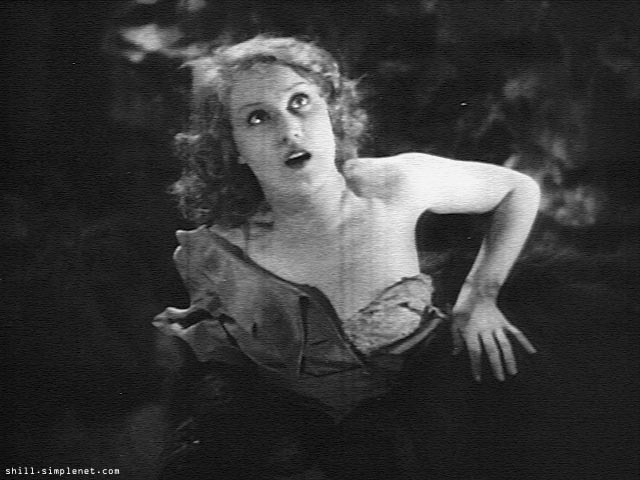
Yesterday word of Fay Wray’s death at age 96 hit the news. Fay Wray, leading lady in the classic 1933 version of KING KONG, screamer extraordinaire and the cinema’s quintessential damsel in distress. The black and white image of her stunning blonde beauty, adorned in naught but a torn teddy while struggling to escape the fearsome-yet-adoring clutches of the thirty-foot monster god of an uncharted island has been carved in stone as a cinematic landmark for seventy-one years and is unforgettable proof of the dream machine that was once the Golden Age of Hollywood.

Upon hearing of Miss Wray’s passing the first thing that crossed my mind was “Was she the last person involved in KING KONG to go?” If she was, she may have been the last of a dying breed, the old-school Hollywood movie star. When one thinks of those who pass for stars these days, that’s a sad thought indeed. Will Keanu Reeves, Brittany Murphy or even Adam Sandler be remembered down the line with the fondness afforded Wray and her contemporaries? I sincerely doubt it, and that’s ironic since Wray publicly bemoaned the fact that the mythic status of her role in KING KONG lead to the overshadowing of every other part she essayed.

With the flagrant love that I have for giant monster films it should come as no surprise to anyone that the 1933 KING KONG is my favorite movie. I say movie because film is a somewhat lofty term often applied to films by artists such as Bergman, Kurosawa and Jarmusch, items of deep examination of the human condition and such. Not so with KONG; KING KONG is a rollicking piece of entertainment, sheer fun from start to finish with nothing on its mind except entertaining its audience and placing the viewer firmly within an adventure into the fantastic. Fun and entertainment is what it’s all about, and by those criteria KING KONG is a great movie.

A Depression-era adventure yarn like no other, KING KONG has mood, romance, thrills and balls-out monster action from start to finish and several sequences that have since become ingrained into the worldwide popular culture. And considering that Kong himself has existed on his island for thousands of years, I have always wondered what his typical day was like. During the harrowing adventure shared by Anne Darrow and Jack Driscoll deep within the teeming jungle of Skull Island, we see Kong handing out ass-whuppings on his fellow jungle denizens like it was Halloween candy. Remove the two hapless humans from that picture and you have to realize that Kong’s day-to-day existence would have sucked most egregiously when he wasn’t being offered native women with which to do God only knows what. I can see it now: the big guy is lumbering down a dense forest path when, suddenly, some primordial crawly thing drops out of a tree and attempts to eat his face. Kong savagely dispatches this creature and continues on his mighty way. Then, without warning, a Tyrannosaurus Rex jumps out a ditch and tries to bite his nuts off. Our giant-ape-about-town puts much foot to scaly ass and vanquishes the errant T-Rex by ripping off its head and taking a big dump down its throat. After foraging for whatever may constitute the diet of a thirty-foot primate, Kong returns to his mountain top lair to chill out and relax. As he reclines and begins to nod off to Slumberland, a giant carrion bird swoops from the skies and tries to lodge its beak up Kong’s hairy ass. Kong clenches his titanic butt-cheek muscles, breaking the bird’s neck like a Mister Salty pretzel stick. Kong then stands atop the corpse, throws back his head and drums on his chest. He lets out a cry of what may appear to be triumph, but he’s more likely saying “Can’t I go through just one day without somebody trying to eat my ass? FUCK!!!”

In honor of Fay Wray’s passing, I watched the film again last night, and it was sort of like attending the wake of someone I’d known since childhood. I just wish that I could have invited everyone I know over to share it with me.

MY LOOK AT THE CINEMA OF 007 Part 1: DR. NO (1962) through DIAMONDS ARE FOREVER (1971)

(Originally published in 2004, but yet to be completed); hey, there are a LOT of James Bond movies)

James Bond, agent 007 of Her Majesty's Secret Service. Adventure hero par excellence, ladies-man, tough guy and all-around bad motherfucker. Part law-enforcer, part school-bully, when the guy enters a room you just know that you're in the presence of the Alpha wolf. It has been said that women want him and that men want to be him. The guy looks good in whatever he wears, gets to play with the coolest (and most destructive) of toys, travels internationally on his government's tab, squares off against megalomaniacal assholes who seriously need killing, and on top of all that he gets more ass than a toilet seat. This is a hero who can't help but to fascinate.

First seeing the light of day in Ian Fleming's 1953 novel CASINO ROYALE, James Bond was envisioned as a somewhat neurotic torpedo for the British government; more cop/investigator than the impossibly suave super-agent who later became a cultural benchmark. He was a very human protagonist, one who admitted fear in the face of almost-certainly lethal peril, and a man who suffered most severely for Queen and country (read most of the Fleming-penned novels to see what I mean, particularly CASINO ROYALE — the infamous encounter between a carpet beater and Bond's dangling, naked nuts will scar you for life — and LIVE AND LET DIE). Fleming, having actually been a British secret agent, brought a tense realism to his hero's adventures and made him into a likable sort who could suddenly become extremely cold and ruthless when the need arose. And the license to kill did not give him the government-sanctioned leave to dispatch folks willy-nilly; he could kill in the line of direct orders or self-defense only, and once his superiors had all the details of a work-related slaying they would use their influence to cover up the messy details.

With such a hero in place and the exotic adventures that he endured guaranteed to whet the appetite of a cold war audience, 007 was destined to be a success. In fact, no less a luminary than John F. Kennedy cited FROM RUSSIA WITH LOVE as one of his favorite novels. That said, the movies inevitably happened, bringing a new level of sex and violence to the screen (although the violence couldn't hold a candle to the insane sadism of the novels), while at the same time altering Bond into a superhero. And while it's easy to look at the content in the Bond films as rather tame by today's jaded standards, keep in mind that these flicks were among the first major releases to include such naughty stuff. When Bond killed somebody it wasn't pretty, and when it looked like he was going to get some punani, you knew that he got some punani. Bond flicks were where moviegoers went for titillation before such stuff was co-opted by big-time Hollywood. (Interesting aside: there was a comedienne whose name eludes me who once remarked that she used to pray to find a boy during her teenage years who could unhook her bra with the ease that she just knew James Bond could.)

Anyhoo, background info now over with, I intend to go off on one of my fabled movie rants, this time devoting my energies (or wasting valuable time —both mine and yours — depending on your point of view) to the long-running James Bond film franchise. I'm sticking strictly to the official series and ignoring the insultingly wretched CASINO ROYALE (1967 version) and the sadly superfluous NEVER SAY NEVER AGAIN (1983). So, without further semi-scholarly film-geekery...

EL BUNCHO RATES THE JAMES BOND FILMS: THE CLASSICS, THE PASSABLE AND THE DOWNRIGHT SUCK-AWFUL.

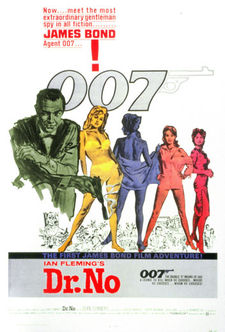
DR. NO (1962) Directed by Terence Young.
The film that started it all.

Sean Connery's first turn as 007 is a study in icy, nonchalant cool as Bond glides from one situation to the next with a sleepy-eyed, perpetually bored sneer on his face. However, other than the fact that this is the first James Bond movie, the film itself remains simply a taught and straightforward (if unremarkable) thriller with Connery's Bond as its saving grace. Oh, and Ursula Andress as Honey Rider is major league eye candy in that bikini (which I've heard on good authority was so smokin' that when Ray Charles was in the audience, he was heard to exclaim "God Damn!!!").

Notes: No theme song, but we get the definitive — and full-length — version of the immortal James Bond theme. Most of the main recurring characters are first seen here, namely Bond, Miss Moneypenny (Lois Maxwell) and M (Bernard Lee). Jack "Hawaii Five-O" Lord shows up as the CIA's frequent liaison for Bond, Felix Leiter. No gadgets, just guns and ass-whuppin' (unless you count the flame-throwing "dragon"). Eunice Gayson appears as Sylvia Trench, the only woman involved with Bond to appear twice. The soundtrack to this is one of the best to listen to at home, and is replete with cheesy early-'60's calypso and Jamaican dance music (including the infectious "Three Blind MIce" and "Kingston Calypso"), so check out the CD. In the source novel the Chinese/German villain (who has steel pincers for hands) meets his justly deserved fate when Bond uses a crane to bury him in several tons of bird shit (I swear to God!!!).

EL BUNCHO RATING: 3 OUT OF 5 - an interesting series opener.

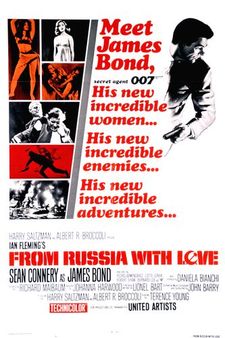
FROM RUSSIA WITH LOVE (1963) Directed by Terence Young.
James Bond is back and the pieces begin to fall into place.

Considered by many (including yours truly) to be the best film in the series, the second Bond outing sticks rather closely to the events of the source novel (one of the very few of the films to do so) with glorious results. International super-criminal organization SPECTRE (the Special Executive for Counterintelligence, Terrorism, Revenge and Extortion) rears its ugly head for the first time and goes after 007 intent on revenge for the loss of Dr. No, who was apparently on their payroll (he worked for the Russians in the novel). The plan: lure 007 with the promise of a Russian decoding device delivered by a beautiful (and horny) Red agent into a situation that is not only an obvious trap, but one that will internationally disgrace the British secret service (it involves SPECTRE agents filming Bond and the enemy agent fucking their brains out through a two-way mirror).

This one is as serious as a heart attack (with a smattering of the humor that would later fist the series right in the ass, but far less obnoxious than it would become) and highlights include a great catfight in a gypsy encampment near Istanbul, Daniella Bianchi as the mouth-watering enemy agent Tatiana Romanova, Lotte Lenya as Rosa Klebb (perhaps cinema's most horrifying bulldyke), Pedro Armendariz as Ali Kerim-Bey — Istanbul's livelier version of M (a part performed as the actor was dying from radiation-induced cancer contracted while filming the John Wayne-as-Genghis Khan-epic THE CONQUEROR, which was filmed at a former atomic test site. Armendariz committed suicide at the end of filming the Bond flick), and Robert Shaw as Donald "Red" Grant, an exceedingly unsavory SPECTRE recruit who engages Bond in the now-famous battle on the Orient Express.

Notes: we get the first attempt at the now-cliché credits & hot chicks sequences, but the theme song (sung by Matt Munro — who?) doesn't show up until the end. The frequently heard "007" instrumental piece makes its debut here during Bond's run-in with an enemy helicopter. Q (Desmond Llewlyn) shows up for the first time, along with one of the most impressive gadgets in the series: the attaché case (if you've seen the movie, you know what I mean. If not, I ain't sayin' nothin'...). Master villain Ernst Stavro Blofeld makes his first appearance in the series, stroking his fluffy kitty and never being seen above the lower ribcage. Eunice Gayson returns for the second (and final) time as the underappreciated romantic-interest Sylvia Trench. Also, Walter Gotell (who would turn up in later films as General Gogol) shows up as the friendly tour guide on SPECTRE Island.

EL BUNCHO RATING: 5 OUT OF 5- A classic from start to finish and not to be missed, especially if you can catch it on the big screen.

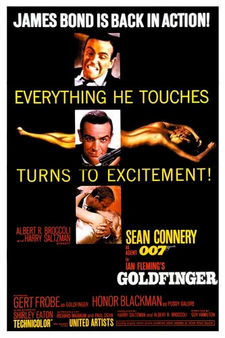
GOLDFINGER (1964) Directed by Guy Hamilton.
This is the one that made your mother get as wet as a swamp.

The third 007 film set the formula for most of the subsequent entries, and went on to launch the worldwide James Bond craze of the mid-1960's. Everything about this one that must have seemed fresh when first seen is so embedded in popular consciousness that it's almost impossible to watch this now and truly get what the big deal was.

Bond runs afoul of Auric Goldfinger, a corpulent Teutonic prick who has an unusual scheme for controlling the world's gold economy, and much mayhem ensues. The villain who reveals his plan in graphic detail, the gimmick henchman (Harold Sakata as the badassed Oddjob), gadgets that veer straight into comic book territory (the marvelous Aston Martin DB 5, which seems well-equipped enough to overthrow most third-world countries), over-abundant one-liners and Bond's transformation into a virtually-unbeatable superman who is a master of every conceivable human activity all begin with this film (despite the fact that he spends a good portion of the film's running time as a captive). The unexpected mega-success of GOLDFINGER led the producers to the obvious conclusion: if it ain't broke, don't fix it. For the next several entries in the series, this film was essentially remade with slight alterations. And don't let my tone turn you off: GOLDFINGER is one of the classic Bonds and you owe it to yourself to check it out.

Notes: GOLDFINGER introduces the pre-credits mini-adventure sequence, this one having absolutely nothing to do with the rest of the story (there was a teaser sequence in the previous film, but it was part of the story). The theme song — ass-kickingly belted out by Shirley Bassey — is one of the undisputed classics of cinema, and perhaps the definitive Bond tune. Honor Blackman makes movie history by getting away with playing a character named Pussy Galore (an overt lesbian in the source novel, Pussy is merely tomboyish in the movie until she has a literal roll in the hay with 007). Designer Ken Adam's low ceiling/sloping walls sensibilities are greatly in evidence here, particularly in Goldfinger's rec room. Bond's CIA pal, Felix Leiter turns up again, this time played by Cec (pronounced "cease") Linder, who is the only actor to date to look like the character was described in the novels (prior to a limb-subtracting run-in with a shark in the novel LIVE AND LET DIE).

This film also features one of the great hero/villain exchanges in movie history. Bond, in the clutches of Goldfinger and nervously watching a laser beam slowly making its way to his family jewels, makes a pitiful attempt at bravado.

BOND: Do you expect me to talk?
GOLDFINGER:(amused) No, Mr. Bond, I expect you to die.

And let us not forget Goldfinger's other great bit of dialogue, directed at a group of mobsters who later end up with a serious case of death:

GOLDFINGER: Man has climbed Mount Everest. Gone to the bottom of the ocean. He has fired rockets to the moon. Split the atom. Achieved miracles in every field of human endeavor...except crime!

And he meant that shit!

EL BUNCHO RATING: 4 OUT OF 5- The carved-in-stone template for what followed for the next three decades.

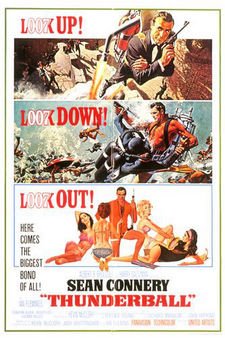
THUNDERBALL (1965) Directed by Terence Young.
So how do you top the success of GOLDFINGER? You guessed it: excess.

The first Bond movie with a running time that passes the two-hour mark, THUNDERBALL was also the first of the 007-as-spectacle films. Bigger budget, bigger action, more women... let's face it, just plain more of every goddamned thing that people liked about Bond. Sadly, this one moves rather slowly, with only occasional signs of life, but it's still worth your time.

007 finds himself in Jamaica investigating the theft of two nuclear warheads that SPECTRE intends to use to extort £100,000,000 from those wacky Brits. My vote for the greatest of all Bond villains, Emilio Largo, is the head of this plot, and he steals the movie by virtue of sheer personality (he's a vicious, misogynistic asshole who enjoys whipping his beautiful mistress when she gets uppity). The other villain of note in this piece is Fiona Volpe, a thermonuclear redhead played by Luciana Paluzzi, who is such a badass that she fucks 007 and throws it back in his face (as he's captured by some of her goons) by stating that his much-lauded cocksmanship would never sway her from her loyalty to SPECTRE, and she sure as hell wasn't kidding.

As for our hero, Sean Connery was the most famous man on the planet by this time and he clearly wasn't enjoying his stardom since he more or less sleepwalks through this film. And Claudine Auger (a former Miss France who actually beat out Raquel Welch for this role) sure fills out a swimsuit as the villain's mistress, but she's utterly boring otherwise.

Notes: THUNDERBALL features a terrific opening sequence that is marred by the unwelcome presence of an improbably placed jet pack and too many bad one-liners (with tons more littered throughout the film). Very few gadgets, but the Aston Martin does turn up during the pre-credits sequence. Rik Van Nutter plays Felix Leiter this time around, and he comes off like a stoned surfer.

The shattering theme song is rendered by a then-unknown Tom Jones, and it gets my vote as the best of the lot.

EL BUNCHO RATING: 2.5 OUT OF 5- Bloated but worth sitting through.

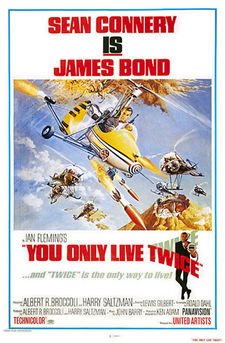
YOU ONLY LIVE TWICE (1967) Directed by Lewis Gilbert.
The budget soars and Connery grows more apathetic.

007 must solve the mystery of who is hijacking space capsules and why. This adventure takes him to Japan, and serves as more of a sumptuous travelogue than anything else. The plot jumps around from set piece to set piece while barely engaging the audience, the villains aren't all that interesting — although we do finally get to see Blofeld face-to-face, and that's a total disappointment since he's scrawny, utterly without a trace of menace and on top of that, his head looks like a cracked boiled egg (Darth Vader in RETURN OF THE JEDI, anyone?). There's also a ludicrous bit of business wherein Bond undergoes plastic surgery to make him look Japanese. Folks, let me tell you that Sean Connery simply does not even remotely resemble an Asian, even when given epicanthic-eye mascara and a slathering of shoe polish. And by the end, the only thing missing from the over-the-top climax is Jimi Hendrix in kabuki makeup playing the James Bond theme. Pointless excess, but eye candy nonetheless. After this, Sean Connery walked away from the series to greener pastures...TO BE CONTINUED.

Notes: this is the first film in the series that earns the description of "wicked fucking stupid," but it is redeemed by being a visual feast. The locations are beautiful and by the time the film is halfway over, you'll want to book a tour of Japan.

The two main Bond girls are played by regulars from the Godzilla movies, namely Akiko Wakabayashi (from GHIDRAH: THE THREE-HEADED MONSTER) and Mie Hama (from MONSTER ZERO, KING KONG ESCAPES and others, who possesses major league, grade A triple-foxhood), and unfortunately both are as dull as dishwater thanks to the idiotic script and horrendous, performance-killing dubbing. Bond's contact in Japan, and their answer to M, is played by Tetsuro Tanba (of FEMALE SLAVE SHIP fame) in a lively performance.

YOU ONLY LIVE TWICE may be the first Western film to feature ninja, who show up in abundance during the climax. The only other things that this film has going for it are Little Nellly (a miniature helicopter that rivals the Aston Martin for sheer destructive capability; it's totally ridiculous but cool if you're under the age of thirteen) and a truly beautiful theme song performed by the otherwise spectacularly untalented Nancy Sinatra ("These Boots Are Made For Walking" and "How Does That Grab You, Darling?" notwithstanding).

By this time, Connery was totally sick of the Bond thing and reportedly began to act like a total douchebag to members of the press, his fans, random passersby, trees... While doing a press junket in Japan, Connery royally pissed off the Japanese public by stating that he did not find Japanese women to be attractive. Great way to promote the flick, genius!

EL BUNCHO RATING: 2.5 OUT OF 5- Watch it for its travelogue aspect.

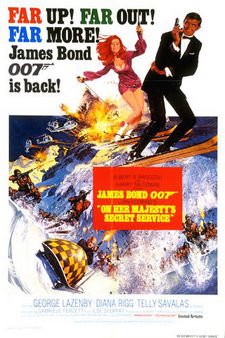
ON HER MAJESTY'S SECRET SERVICE (1969) Directed by Peter Hunt.
Exit the Scotsman, enter the Aussie.

007 has been tracking Blofeld for two years and has found him living in Switzerland, posing as an altruistic allergist. Blofeld's real agenda: international dissemination of a virus that will render the world sterile. With the assistance of a likable crime lord, Bond saves the day and also finds the time to fall in love with — and marry! — the crime lord's suicidal daughter. Sadly, as all seems right in Bond's world, tragedy rears its ugly head...

Exit Sean Connery, enter... George Lazenby??? Yes, Connery was replaced by an Australian former male fashion model with no previous acting experience. Not the best of ideas, but somehow not as bad as it could have been. Lazenby makes up for his lack of acting chops by being the best fighter out of all of the Bond actors; the blows he lands look like they slapped the taste out of the mouths of those on the receiving end. He's rather dashing too, and has a certain cool about him, which only makes it infuriating to know that he took the poor advice of his agent — who felt that the success of EASY RIDER and other such "youth" flicks spelled the imminent end of the Bond franchise — and bowed out in favor of greener pastures. Kreskin he ain't.

As for the other aspects of the film, this is a top-notch 007 outing in every way. Telly Savalas makes a great Blofeld, one who finally delivers on the menace promised in previous installments. He's suave, calculating, and every inch a worthy opponent for our hero. Diana Rigg shines as the tortured, self-destructive Tracy, the first of the Bond women with serious depth. It's easy to see why Bond falls for her, and she actually brings out a hitherto unseen tenderness in 007. She's a class act all the way. There's no theme song, but we do get an excellent instrumental during the titles. The vocal highlight is Louis Armstrong's touching "We Have All The Time In The World," used to great effect during the scenes of Bond and Tracy's courtship. Low on gadgets, high on action and plot, On Her Majesty's Secret Service is a strong contender for the title of best Bond film ever made, and would have earned that honor if Sean Connery had stuck around.

EL BUNCHO RATING: 4.5 out of 5- minus half a point for the absence of Sean Connery, but a winner all the way. Do not miss this one.

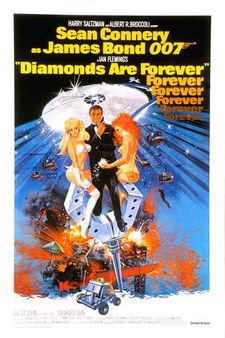
DIAMONDS ARE FOREVER (1971) Directed by Guy Hamilton.
Who's the old, fat guy with the hairpiece and faggy wardrobe? HOLY SHIT! It's Sean Connery!!!

After George Lazenby moved on to appear in such cinematic classics as the unwatchable kung fu time-waster STONER (1974) and the John "Full House" Stamos-versus-megalomaniacial-hermaphrodite espionage howler NEVER TOO YOUNG TO DIE (1986), the Bond producers managed to lure Sean Connery back into bondage with a paycheck of $1,250,000, 12.5 percent of the gross profits, $145,000 for every week that the film went over schedule, and a promise that United Artists would bankroll any two films of his choosing. Sure, Connery's presence guaranteed box office, but four years had passed since he last stepped in front of the camera as 007. He was now forty-one years old, somewhat overweight/bloated, graying and obviously in need of a decent toupee. Get ready, folks: James Bond is back, and now he's your dad!

007 is hot on the trail of smuggled diamonds which are being used as components for a gigantic orbital death ray, a plan masterminded by Blofeld (now played by Charles The Rocky Horror Picture Show Gray). Slightly-entertaining run-ins with Las Vegas mobsters, badass wrasslin' chicks and a pair of homosexual hitmen can't hide the fact that this film has a convoluted and rather boring story , and a distinctly Smokey and the Bandit flavor permeates the the proceedings. The usual explosive finale on an oil rig is anything but stirring, and feels as tired as Kunta Kinte after the bloodhound marathon. In short, this one is a serious loser.

Notes: Shirley Bassey's theme song; her voice is terrific, but listen to the lyrics to truly get how great this tune is. Gay hitmen Kidd and Wint are fun too and they should have been more prominent throughout. But NOOOOOOOOOO...

EL BUNCHO RATING: 1 OUT OF 5- dumb, dumb, dumb and just plain bad. One of the few that I'll never sit through again.

JAMES BOND WILL RETURN IN PART TWO: THE ROGER MOORE YEARS (whenever I get around to sitting through that cavalcade of almost total awfulness)